
Commonwood Farm has undertaken a number of great projects on the Braidwood Common. These are made possible by our members, our collaboration with the Braidwood Urban Landcare Group, our supportive funding partners, and the hard work of many awesome local volunteers.
The Walking trail
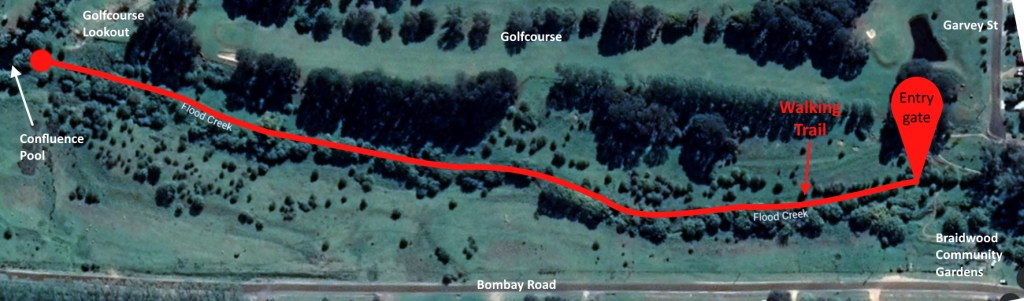
We have created a walking trail along the northern bank of Flood Creek, between the Braidwood Community Gardens and the confluence pool below the golf course lookout. This walking trail adds to the amenity of the upstream Flood Creek footpath, which was created by the Braidwood Urban Landcare Group in 2010. The path runs close to Flood Creek and provides opportunities to encounter local wildlife. There are regular sightings of platypus and rakali, as well as numerous bird species. The gate to the Common walking trail is visible from the Flood Creek footbridge, on the opposite side to the Community Gardens. The walking trail is open to members of the public and is for the enjoyment of all Braidwood locals and visitors. We ask that dogs be kept on a leash at all times to avoid disturbing wildlife and livestock.
Riparian fencing
We have fenced the riparian zone of the common on both sides of Flood Creek and Gillamatong Creek. Project materials were funded by the Sydney Catchment Authority (now WaterNSW) as part of their riparian landholders grants. Fence construction was completed by the leasee with help from three awesome ‘Green Army’ crews hosted by the Upper Shoalhaven Landcare Council.
The ‘Green Wedge’ western fire defence
During the catastrophic black summer fires of 2020 the North Black Ridge fire swept through Bombay and jumped the Shoalhaven River, threatening the town of Braidwood where many outlying residents were sheltering. Although the fire was diverted before it reached our town, the threat lasted for days and the local RFS bulldozed firebreaks across the Braidwood Common. To help combat future fire events, Commonwood Farm has installed permanent gated access for fire vehicles behind two planted firebreaks of low-flammability tree species, near to accessible water (more details here). Funding for this project was awarded as part of State and Federal Bushfire Recovery grants.
Non-destructive revegetation demonstration
The non-native riparian forest corridor on Braidwood common is inhabited and regularly used by native wildlife. We are trialling a form of non-destructive revegetation in a section of this corridor. This involves fencing both sides of the creek to exclude grazing stock, then planting native trees and shrubs without first destroying the pre-existing non-native habitat. The most notable indicator of our early success is the continued presence of wildlife in this area. All vegetation has been planted by our visiting Green Army crews, members of Commonwood Farm, the Braidwood Urban Landcare Group, and Flood Creek Non-nativist Landcare Group.
Internal fencing for rotational grazing
With help from students of the Braidwood Central School agriculture programme, we are gradually dividing the common into smaller paddocks suitable for ‘rotational’ or ‘cell’ grazing. This practice enables more intense grazing followed by periods of rest in each paddock which will support the growth of palatable grasses and help to suppress weeds. Funding for fencing and off-stream watering was contributed by WaterNSW under their riparian landholder assistance scheme.
Trees and shrubs for Glossy-Black Cockatoos and the Scarlet Robin
With funding from the Communities Environment Program, local volunteers from Commonwood Farm, the Braidwood Urban Landcare Group, and the wider Braidwood Community have planted trees and shrubs to provide feed for Glossy-Black Cockatoos and shelter for the Scarlet Robin. 280 Casuarinas and around 50 shrubs have been planted so far, with more to come.

 Commonwood Farm Braidwood